Description
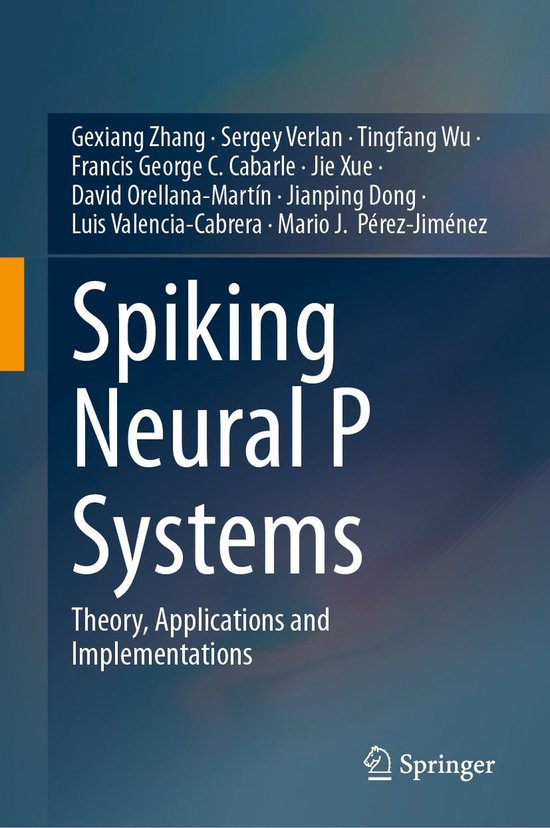
Spiking neural P systems represent a significant advancement in the field of membrane computing, drawing inspiration from the communication patterns observed in neurons. Since their inception in 2006, these distributed and parallel neural-like computing models have gained popularity and emerged as important tools within the membrane computing area. As a key branch of the third generation of artificial neural networks, a fascinating research area of artificial intelligence, spiking neural P systems offer a captivating blend of theoretical elegance and practical utility. Their efficiency, Turing completeness, and real-life application characteristics, including interpretability and suitability for large-scale problems, have positioned them at the forefront of contemporary research in membrane computing and artificial intelligence.
This state-of-the-art reference work is organized into three parts comprising twelve chapters. It thoroughly investigates the theoretical foundations, real-life applications, and implementations of spiking neural P systems. From fundamental principles to computational power and complexity, the theoretical aspects are explored, laying the groundwork for understanding their practical applications. Real-life applications span a diverse range of domains, including complex optimization, classification, fault diagnosis, medical image processing, information fusion, cryptography, and robot control. Additionally, the book discusses several software and hardware implementations that provide valuable insights into the practical deployment of spiking neural P systems.
As the rapid development of spiking neural P systems continues to unfold, there is an increasing demand for a systematic and comprehensive summary of their capabilities and applications. This work serves as an invaluable resource for researchers, scholars, and practitioners interested in the theoretical underpinnings, algorithms, and practical implementation of artificial intelligence and membrane computing.
- Langue
- en
- Version
- livre numérique
- Date de sortie initiale
- 13 décembre 2024
- Format ebook
- EPUB3
- Illustrations
- Avec illustrations
Personnes impliquées
- Auteur principal
-
Gexiang Zhang
- Deuxième auteur
-
Sergey Verlan
- Editeur principal
-
Springer
Options de lecture
- Lisez cet ebook sur
- Android (smartphone et tablette)Windows (smartphone et tablette)Ordinateur de bureau (Mac et Windows)Lecteur électronique KoboiOS (smartphone et tablette)
Informations sur le fabricant
- Informations sur le fabricant
- Les informations du fabricant ne sont actuellement pas disponibles
Autres spécifications
- Livre d‘étude
- Oui
EAN
- EAN
- 9789819792825
Sécurité des produits
- Opérateur économique responsable dans l’UE
-
Afficher les données
Vous trouverez cet article :
- Catégories
-
Ordinateurs et Informatique
Technologies informatiques
Intelligence artificielle
Mathématiques pour informaticiens
Apprentissage automatique
Livres
- Livre, ebook ou livre audio ?
-
Ebook
- Disponibilité
-
Disponible à l’adresse suivante
- Langue
-
Anglais
- Toegankelijkheidsinformatie
-
Bevat toegankelijkheidskenmerken