Description
‘Laurent Fourchard’s deep, first-hand knowledge of the history and contemporary politics of Nigeria and South Africa forms the basis of an insightful and compelling analysis of how states produce invidious distinctions among their people and at the same time how political linkages are forged between state and society, elites and subalterns, bureaucratic structures and personal relations.’Frederick Cooper, Professor of History, New York University, USA
‘Violence, control, police and political order are essential dimensions of metropolis. In this exceptional book, Laurent Fourchard compares decentralised exercises of authority in providing vivid analysis of exclusion of youth and migrants, policing and riots, politics of “Big men” and fine-grained blurring between bureaucracy and society. A masterpiece of urban politics.’Patrick Le Galès, Dean of Urban School, Sciences Po Paris, France
‘This book is a major contribution to rethinking urban politics from the experiences of African cities. Based on detailed historical analysis of South Africa and Nigeria, Fourchard recalibrates the actors, stakes and terms of urban politics around African-centred concerns.’ Jennifer Robinson, Professor of Geography, University College London, UK
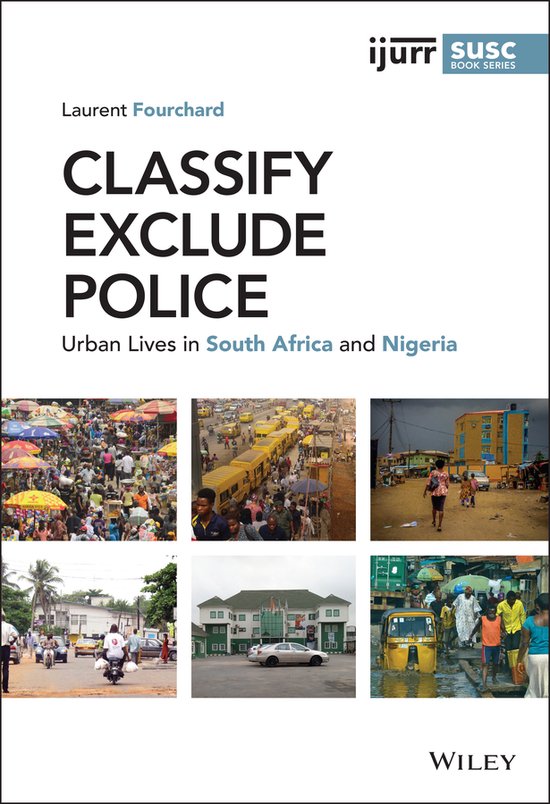
The cities of South Africa and Nigeria are reputed to be dangerous, teeming with slums, and dominated by the informal economy but we know little about how people are divided up, categorised and policed. Colonial governments assigned rights and punishments, banned categories considered problematic (delinquents, migrants, single women, street vendors) and give non-state organisations the power to police low-income neighbourhoods. Within this enduring legacy, a tangle of petty arrangements has developed to circumvent exclusion to public places and government offices. In this unpredictable urban reality ??? which has eluded all planning ??? individuals and social groups have changed areas of public action through exclusion, violence and negotiation.
In combining historical and ethnographic methods, Classify, Exclude, Police explores the effects and limits of public action, and questions the possibility of comparison between cities often perceived as incommensurable. Focusing on state formation, urbanization, and daily lives, Laurent Fourchard addresses debates and controversies in comparative urban studies, history, political science, and urban anthropology. The book provides a systematic, comparative approach to the practices, processes, arrangements used to create boundaries, direct violence, and produce social, racial, gender, and`generational differences.
>CLASSIFY, EXCLUDE, POLICE
‘Laurent Fourchard’s deep, first-hand knowledge of the history and contemporary politics of Nigeria and South Africa forms the basis of an insightful and compelling analysis of how states produce invidious distinctions among their people and at the same time how political linkages are forged between state and society, elites and subalterns, bureaucratic structures and personal relations.’Frederick Cooper, Professor of History, New York University, USA
‘Violence, control, police and political order are essential dimensions of metropolis. In this exceptional book, Laurent Fourchard compares decentralised exercises of authority in providing vivid analysis of exclusion of youth and migrants, policing and riots, politics of “Big men” and fine-grained blurring between bureaucracy and society. A masterpiece of urban politics.’Patrick Le Galès, Dean of Urban School, Sciences Po Paris, France
‘This book is a major contribution to rethinking urban politics from the experiences of African cities. Based on detailed historical analysis of South Africa and Nigeria, Fourchard recalibrates the actors, stakes and terms of urban politics around African-centred concerns.’ Jennifer Robinson, Professor of Geography, University College London, UK
The cities of South Africa and Nigeria are reputed to be dangerous, teeming with slums, and dominated by the informal economy but we know little about how people are divided up, categorised and policed. Colonial governments assigned rights and punishments, banned categories considered problematic (delinquents, migrants, single women, street vendors) and give non-state organisations the power to police low-income neighbourhoods. Within this enduring legacy, a tangle of petty arrangements has developed to circumvent exclusion to public places and government offices. In this unpredictable urban reality ??? which has eluded all planning ??? individuals and social groups have changed areas of public action through exclusion, violence and negotiation.
In combining historical and ethnographic methods, Classify, Exclude, Police explores the effects and limits of public action, and questions the possibility of comparison between cities often perceived as incommensurable. Focusing on state formation, urbanization, and daily lives, Laurent Fourchard addresses debates and controversies in comparative urban studies, history, political science, and urban anthropology. The book provides a systematic, comparative approach to the practices, processes, arrangements used to create boundaries, direct violence, and produce social, racial, gender, and`generational differences.
- Langue
- en
- Version
- Couverture rigide
- Date de sortie initiale
- 06 mai 2021
- Nombre de pages
- 304
- Illustrations
- Non
Personnes impliquées
- Auteur principal
-
Laurent Fourchard
- Editeur principal
-
John Wiley & Sons Inc
Informations sur le fabricant
- Nom du fabricant
- Wiley-VCH GmbH
- Adresse du fabricant
- Boschstrasse 12 | 69469| Weinheim| DE
- Adresse électronique du fabricant
- product_safety@wiley.com
- Informations sur le fabricant
- Les informations du fabricant ne sont actuellement pas disponibles
Autres spécifications
- Hauteur de l’emballage
- 22 mm
- Hauteur du produit
- 22 mm
- Largeur d’emballage
- 152 mm
- Largeur du produit
- 152 mm
- Livre d‘étude
- Non
- Longueur d’emballage
- 229 mm
- Longueur du produit
- 229 mm
- Poids de l’emballage
- 567 g
- Porno
- Non
EAN
- EAN
- 9781119582625
Sécurité des produits
- Opérateur économique responsable dans l’UE
-
Afficher les données
Vous trouverez cet article :
- Catégories
-
Hommes et société
Science et nature
Politique
Terre et environnement
Géographie
Livres
- Livre, ebook ou livre audio ?
-
Livre
- Disponibilité
-
Disponible à l’adresse suivante
- Langue
-
Anglais
- Type de livre
-
Hardcover