Description
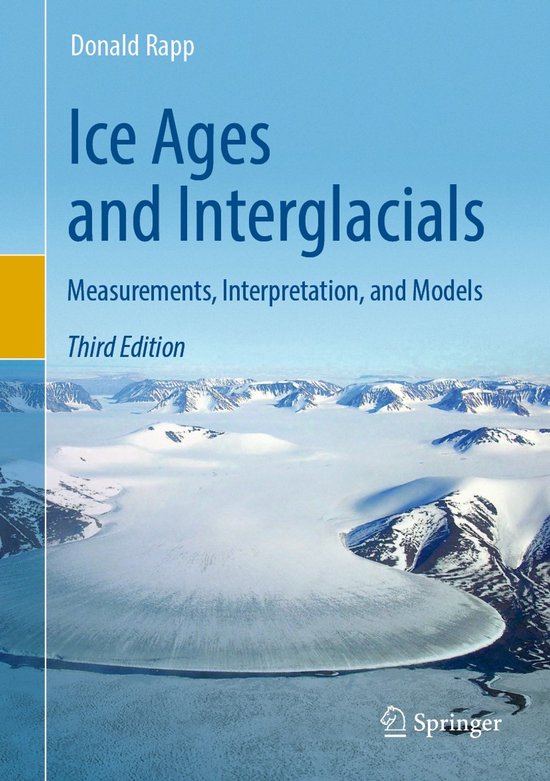
This book provides a detailed review of terminations of ice ages, including a very attractive theory based on dust deposits on ice sheets.
It is not so long ago (a mere 17,000 years – a blink in geologic time) that vast areas of the Northern Hemisphere were covered with ice sheets up to two miles thick, lowering the oceans by more than 120 m. By 11,000 years ago, most of the ice was gone.
Evidence from polar ice cores and ocean sediments show that Ice Ages were persistent and recurrent over the past 800,000 years. The data suggests that Ice Ages were the normal state, and were temporarily interrupted by interglacial warm periods about nine times during this period.
Quasi-periodic variations in the Earth cause the solar input to high northern latitudes to vary with time over thousands of years. The widely accepted Milankovitch theory implies that the interglacial warm periods are associated with high solar input to high northern latitudes. However, many periods of high solar input to high northern latitudes occur during Ice Ages while the ice sheets remain.
The data also indicates that Ice Ages will persist regardless of solar input to high northern latitudes, until several conditions are met that are necessary to generate a termination of an Ice Age. An Ice Age will not terminate until it has been maturing for many tens of thousands of years leading to a reduction of the atmospheric CO2 concentration to less than 200 ppm. At that point, CO2 starvation coupled with lower temperatures will cause desertification of marginal regions, leading to the generation of large quantities of dust. High winds transfer this dust to the ice sheets greatly increasing their solar absorptivity, and at the next up-lobe in the solar input to high northern latitudes, solar power melts the ice sheets over about a 6,000-year interval.
A warm interglacial period follows, during which dust levels drop remarkably. Slowly but surely, ice begins accumulating again at high northern latitudes and an incipient new Ice Age begins.
This third edition presents data and models to support this theory.
- Langue
- en
- Version
- Couverture rigide
- Date de sortie initiale
- 29 avril 2019
- Nombre de pages
- 346
- Illustrations
- Non
Personnes impliquées
- Auteur principal
-
Donald Rapp
- Deuxième auteur
-
Rapp
- Editeur principal
-
Springer
Informations sur le fabricant
- Nom du fabricant
- Springer Nature Customer Service Center GmbH
- Adresse du fabricant
- Europaplatz 3 | 69115| Heidelberg| DE
- Adresse électronique du fabricant
- ProductSafety@springernature.com
- Informations sur le fabricant
- Les informations du fabricant ne sont actuellement pas disponibles
Autres spécifications
- Hauteur de l’emballage
- 240 mm
- Largeur d’emballage
- 168 mm
- Largeur du produit
- 168 mm
- Livre d‘étude
- Non
- Longueur d’emballage
- 240 mm
- Longueur du produit
- 240 mm
- Poids de l’emballage
- 800 g
- Police de caractères extra large
- Non
- Édition
- 3
EAN
- EAN
- 9783030104658
Sécurité des produits
- Opérateur économique responsable dans l’UE
-
Afficher les données
Vous trouverez cet article :
- Catégories
-
Science et nature
Terre et environnement
Astronomie
Sciences de la terre
Mer et eaux intérieures
Météo et climat
Livres
- Livre, ebook ou livre audio ?
-
Livre
- Disponibilité
-
Disponible à l’adresse suivante
- Langue
-
Anglais
- Type de livre
-
Hardcover